What’s Covered in Our First Aid Courses?
CPR, injuries and more: what you learn on each course.
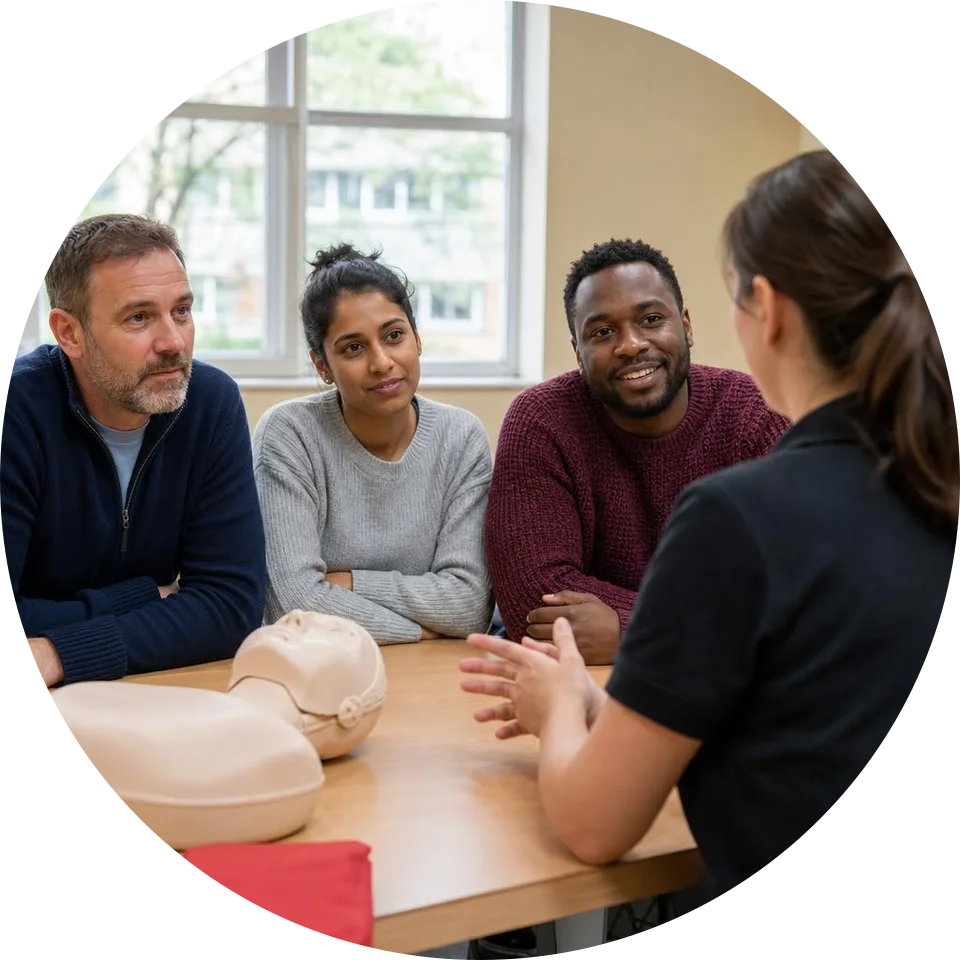
You’ll learn CPR, how to use a defibrillator, how to help someone who is choking, and how to deal with injuries and sudden illness.
We get practical with CPR manikins, defibrillators, choking jackets, EpiPen trainers and more. Here’s what each course covers.
Core Emergency Skills
Across our main courses, learners practise Cardiopulmonary resuscitation (CPR), using an automated external defibrillator (AED), helping someone who is choking and caring for an unresponsive person. You also learn to assess an incident, make the scene safer, call for help and explain what has happened.
Training covers immediate emergencies such as bleeding, burns, fainting, seizures and shock, alongside recognising signs that someone is seriously unwell.
Workplace First Aid: Emergency First Aid at Work (EFAW) and First Aid at Work (FAW)
Emergency First Aid at Work is our standard one-day workplace course. Alongside CPR and choking, it covers injuries and sudden illness, including burns, broken bones, heart attacks and strokes. We include practical EpiPen training.
Full First Aid at Work goes further with First Aid kits, checking someone for life-threatening problems and then other injuries (called primary and secondary surveys), and a wider range of injuries and illnesses, including:
Full FAW has three days of learning, including a blended option with two days online and one day in person.
Baby and Child First Aid
Both Emergency Paediatric and 12-hour Paediatric First Aid include baby and child CPR, choking, bleeding, burns and EpiPen practice. The full course adds training in a wider range of injuries and illnesses, including:
The full qualification combines six hours online with six hours in person. It is the usual choice for childminders and designated early years cover.
We can cover adult and child skills together. You receive the certificate for the course you choose.
Basic Life Support
Basic Life Support focuses on CPR, using a defibrillator, choking and helping an unresponsive person. You also practise the recovery position and how to assess an emergency.
Can You Customise Our Training?
Yes. On private courses, we use examples from your workplace. A hotel team might practise helping a guest who collapses; a factory team might focus on injuries around machinery.
Tell us what your team wants to learn. We cover those concerns alongside the skills needed for your chosen course.
Find the Right Training for Your Team
Book a place on a public course, or arrange a private course at your workplace, customised to your team.
Need a hand? Contact our friendly team.
How Can We Serve You?
Get In Touch.
EXPLORE OUR COURSES
