Baby and Child Choking: Watch Jo-Anne Demonstrate
A practical demonstration from Jo-Anne, our lead trainer.
The way you help a choking baby is different from the way you help an older child. In this video, Jo-Anne, our lead trainer at Manchester First Aid Training, demonstrates baby and child choking First Aid.
Watch the demonstration, then read the key points below. This article supports practical learning; it does not replace hands-on training.
If a baby or child is choking now and cannot breathe, cry or cough effectively, call 999 immediately or ask someone to call. Use speakerphone and follow the call handler’s instructions. Do not wait to watch a video.
Watch Jo-Anne’s Choking Demonstration
Seeing the techniques demonstrated can help you understand the difference between helping a baby and helping a child. Here is Jo-Anne’s demonstration from Manchester First Aid Training.
If the player does not load, watch Jo-Anne’s demonstration on YouTube.
Recognise When a Child Needs Help
A child who can cough loudly, breathe and make sounds may be able to clear the blockage. Encourage an older child to cough and stay close. Keep watching for any change.
A weak or silent cough, difficulty breathing, or being unable to speak or cry can mean the airway is seriously blocked. Shout for help and have someone call 999 as soon as possible. If you are alone with a phone, use speakerphone so you can help at the same time.
Do not put your fingers into the mouth to search for an object. Only remove something you can clearly see and easily reach.
Helping a Baby Under One
If the baby cannot cough effectively, give up to five back blows. Support the baby face down along your forearm, resting your arm on your leg. Support the head and keep it lower than the chest. Give a sharp blow between the shoulder blades, checking after each one.
If the blockage has not cleared, turn the baby face up, keeping the head supported and lower than the chest, and give up to five chest thrusts. The Resuscitation Council UK’s 2025 guidance describes the two-thumb encircling technique: encircle the chest with your hands and use both thumbs on the lower half of the breastbone to give sharper thrusts than CPR compressions.
Do not use abdominal thrusts on a baby under one. While the baby remains conscious, alternate up to five back blows with up to five chest thrusts. Stop as soon as the blockage clears. Practise the positioning and technique with a trainer using a baby manikin, not on a healthy baby.
Helping a Child Aged One or Over
If coughing is ineffective, lean the child forwards and give up to five back blows between the shoulder blades. Check after each blow and stop if the blockage clears.
If back blows do not work, give up to five abdominal thrusts. Stand or kneel behind the child, put your arms around the upper abdomen and lean them forwards. Place a clenched fist between the belly button and the bottom of the breastbone, grasp it with your other hand and pull sharply inwards and upwards.
While the child remains conscious, keep alternating up to five back blows with up to five abdominal thrusts until the blockage clears or they become unresponsive. Keep the emergency call handler informed.
If They Become Unresponsive
Lower the baby or child carefully onto a firm, flat surface. Make sure 999 has been called and start CPR, beginning with five rescue breaths. Follow the call handler’s instructions and your training.
For rescuers trained in Paediatric Basic Life Support, the compression-to-breath ratio is 15 to 2. Otherwise, use 30 to 2. If you cannot give rescue breaths, give chest compressions rather than doing nothing and follow the call handler’s advice.
When opening the airway, remove an obstruction only if it is clearly visible. Never use a blind finger sweep.
After the Blockage Clears
Get medical help even if the object comes out. Part of it may still be in the airway, or the baby or child may have been injured during the choking or the First Aid. Tell the healthcare professional what happened and whether you used back blows, chest thrusts or abdominal thrusts.
Keep watching their breathing and responsiveness. If either worsens, call 999 and follow the call handler’s instructions.
Build Confidence With Hands-on Practice
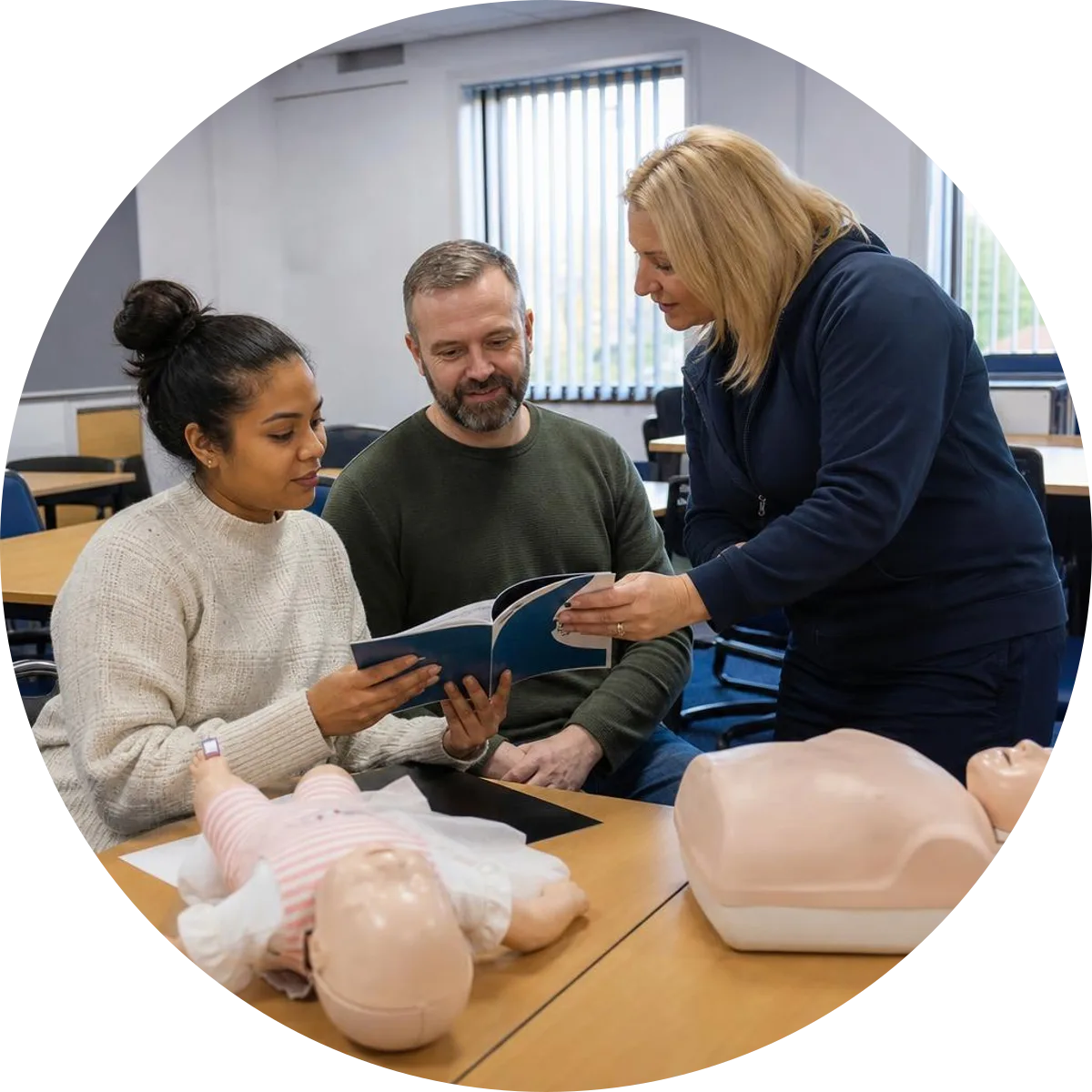
Watching a demonstration is useful, but practising with a trainer gives you the chance to ask questions, check your hand position and work through the sequence.
Baby and child choking skills are included in both our Emergency Paediatric First Aid and Full Paediatric First Aid courses. They also cover baby and child CPR, bleeding, burns and practical EpiPen training.
For nurseries, schools and childcare teams, we can arrange a private course at your workplace and use examples relevant to the children you care for. If you are booking for yourself, explore our public Paediatric courses or ask our team which option fits your needs.
Practise Baby and Child First Aid
Learn the techniques, ask questions and build your confidence with practical Paediatric First Aid training.
Booking for your team? Ask about training at your workplace.
How Can We Serve You?
Get In Touch.
EXPLORE OUR COURSES
